
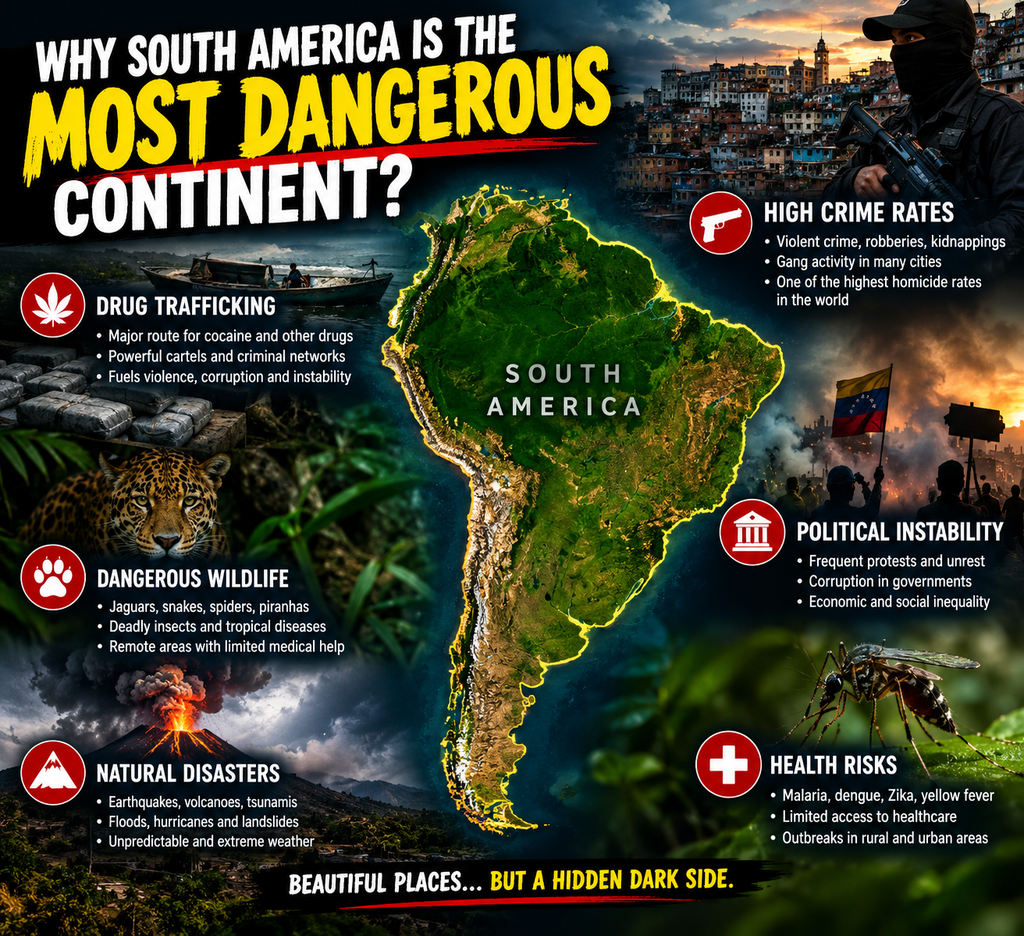
South America is a continent of extraordinary natural beauty, rich cultures, and rapidly developing cities. However, it is also frequently associated with high levels of violent crime, organized criminal activity, and political and economic instability in some countries. Calling it “the most dangerous continent on Earth” is an oversimplification, because safety varies enormously between countries and even between neighborhoods. Nevertheless, several factors explain why parts of South America have developed this reputation.
One major concern is violent crime. Some South American cities experience high rates of homicide, robbery, kidnapping, and assault. Countries such as Brazil, Colombia, Ecuador, and Venezuela have struggled with serious crime problems in particular regions. Large urban areas can contain neighborhoods where organized criminal groups have significant influence. Tourists and residents may face risks such as armed robbery, carjacking, and theft, especially in areas known for criminal activity.
Another important factor is organized crime and drug trafficking. South America is a major producer of cocaine, particularly in countries such as Colombia, Peru, and Bolivia. Drug-trafficking organizations operate sophisticated networks that transport illegal drugs across borders and into North America, Europe, and other regions. Competition between criminal organizations can lead to violent conflicts, particularly in strategic locations near borders, ports, and major transportation routes.
Gang activity is another serious issue in some parts of the continent. Criminal groups may control certain neighborhoods and become involved in extortion, illegal weapons, drug distribution, and territorial disputes. In some areas, ordinary residents can become caught between rival groups or face pressure from criminal organizations.
Economic inequality also contributes to insecurity. South America contains enormous differences in wealth. Modern financial districts and wealthy neighborhoods can exist only a short distance from impoverished communities. Poverty itself does not cause crime, but limited employment opportunities, weak social services, and inequality can create conditions in which criminal organizations find it easier to recruit members.
Political and institutional problems can also affect public safety. In some countries, corruption, weak law enforcement, overcrowded prisons, and slow judicial systems make it difficult to control organized crime effectively. When criminals believe that the likelihood of punishment is low, criminal activity can become more difficult to contain.
Geography creates additional challenges. The continent contains enormous forests, mountains, remote borders, and vast rural areas. These difficult-to-monitor regions can provide opportunities for illegal mining, drug production, smuggling, and other illicit activities.
However, it is important not to portray all of South America as dangerous. Countries such as Uruguay, Chile, and Argentina generally have different security conditions from the most violent areas of the continent, and millions of tourists visit South America safely every year. Even within countries with high crime rates, many neighborhoods are perfectly safe.
Ultimately, South America’s reputation for danger comes from a combination of violent crime, organized crime, drug trafficking, inequality, corruption, and localized political instability. But describing an entire continent as “the most dangerous on Earth” ignores its enormous diversity. South America is better understood as a continent containing both relatively safe societies and some exceptionally high-risk areas. The real danger depends heavily on the country, city, neighborhood, and circumstances rather than the continent as a whole.
Leave a Reply