
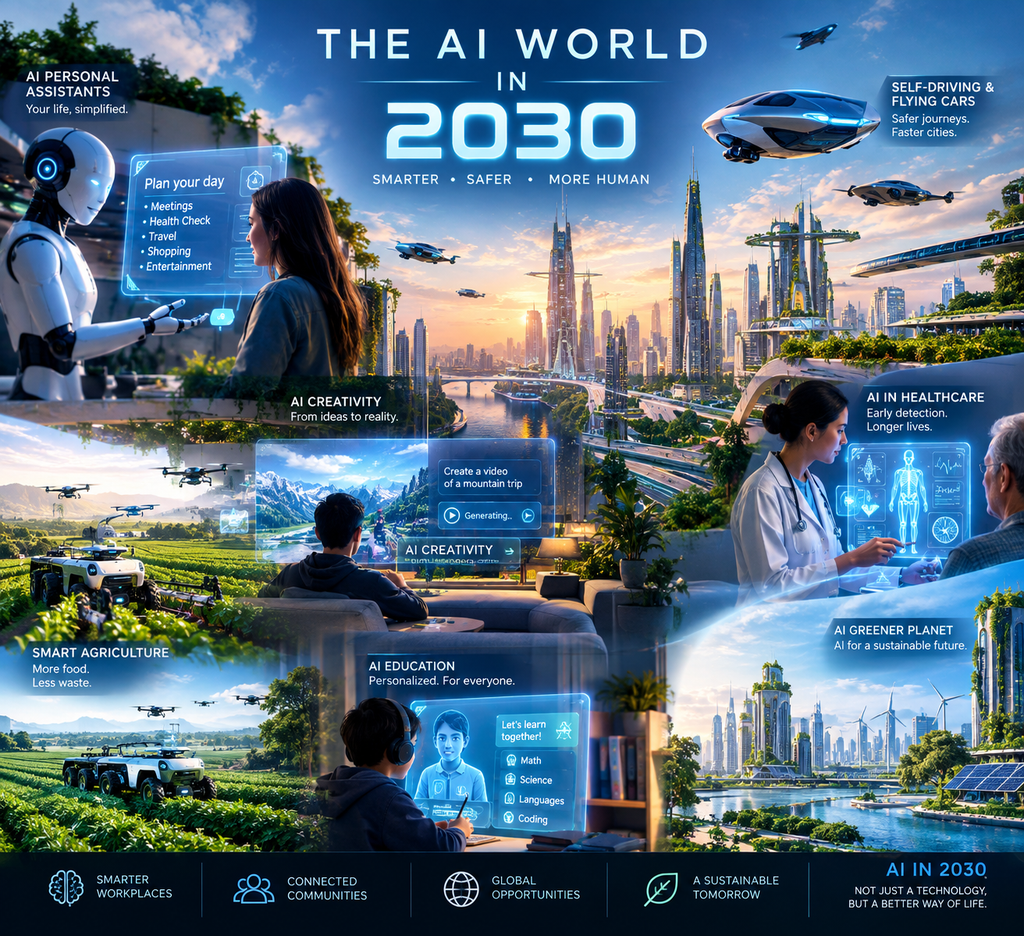
Artificial Intelligence (AI) is no longer a technology limited to science-fiction movies or research laboratories. From chat-bots and smart assistants to self-driving technology and AI-powered medical tools, artificial intelligence is already becoming part of everyday life. But the biggest changes may still be ahead. By 2030, AI could transform the way we work, learn, travel, communicate, and even make everyday decisions.
1. AI Will Transform the Workplace
By 2030, AI is expected to become a regular partner in many workplaces. Instead of simply replacing humans, AI will increasingly handle repetitive tasks such as data entry, scheduling, document analysis, customer support, and basic content creation.
This could allow people to spend more time on creativity, problem-solving, leadership, and decision-making. At the same time, some jobs may disappear or change significantly, while new careers related to AI development, safety, data, robotics, and AI management could emerge.
The workplace of 2030 may therefore be less about humans competing against machines and more about humans working alongside them.
2. Education Could Become Highly Personalized
Education is another area that could experience a major transformation. AI-powered tutors may provide students with personalized lessons based on their individual strengths and weaknesses.
Instead of every student following exactly the same learning speed, AI could adjust explanations, questions, and exercises according to each learner. A student struggling with mathematics, for example, could receive additional explanations and practice until the concept becomes clear.
Teachers will still play an important role, but AI could become a powerful assistant that helps them understand students’ learning needs and reduce administrative work.
3. Healthcare Could Become Smarter
AI could also revolutionize healthcare by helping doctors detect diseases earlier and analyze enormous amounts of medical information. AI systems may assist with medical imaging, drug discovery, treatment planning, and monitoring patients.
Wearable devices could continuously track information such as heart rate, sleep, and physical activity, allowing AI systems to identify unusual patterns and encourage people to seek professional medical advice when necessary.
However, AI should support healthcare professionals rather than replace human medical judgment.
4. Smarter Homes and Transportation
By 2030, smart homes could become considerably more intelligent. AI may automatically manage lighting, temperature, security, appliances, and energy consumption according to people’s habits.
Transportation could also change dramatically. More advanced driver-assistance systems and autonomous vehicles could make roads safer and reduce the stress of driving. AI could optimize traffic signals and public transportation systems, potentially reducing congestion in crowded cities.
5. The Challenges of an AI-Powered Future
Despite its enormous potential, AI will bring serious challenges. Privacy, misinformation, cybersecurity, job displacement, and the misuse of AI-generated content are issues that society will need to address.
Governments, technology companies, educators, and individuals will need to establish responsible rules for using AI. Human judgment, ethics, creativity, and empathy will remain essential even as machines become more capable.
Conclusion
By 2030, artificial intelligence could become almost invisible because it will be integrated into so many parts of our daily lives. It may help us work faster, learn more effectively, receive better healthcare, and live in smarter cities.
The future of AI will ultimately depend not only on how powerful the technology becomes, but on how responsibly humanity chooses to use it. AI could change our lives dramatically—but the decisions we make today will determine whether that change leads to a better future.
Leave a Reply