
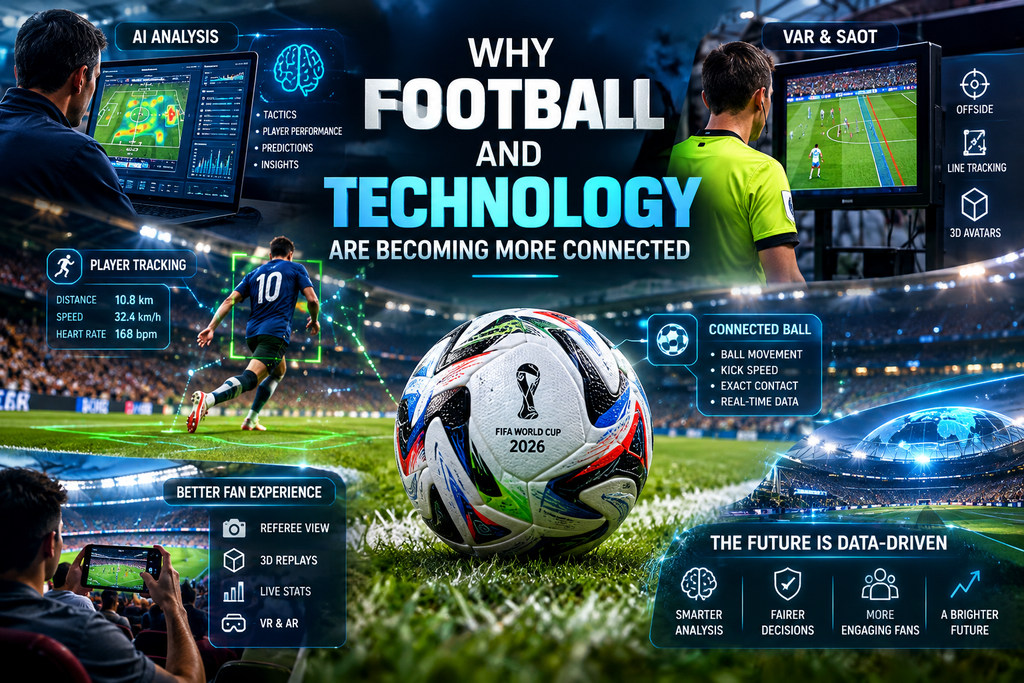
Football has always been a game of skill, passion, tactics and human instinct. But in 2026, technology has become an increasingly important part of the sport. From artificial intelligence and video refereeing to smart footballs and player tracking, modern technology is changing how football is played, managed, analyzed and watched.
The connection between football and technology is no longer limited to television broadcasts or electronic scoreboards. Today, advanced systems can collect enormous amounts of information from a match and turn that data into useful insights for referees, coaches, players and fans.
AI Is Changing Football Analysis
Artificial intelligence is becoming one of the most interesting developments in modern football. AI can analyze huge amounts of match data, helping teams understand player movements, tactical patterns and performances.
Ahead of the 2026 FIFA World Cup, FIFA introduced Football AI Pro, an AI-powered analysis assistant designed to provide teams with advanced per-match and post-match insights. FIFA says the system can analyze large quantities of football data and present information through text, video, graphs and 3D visualizations.
This means coaches can spend less time manually searching through data and more time using those insights to prepare tactics.
VAR and Semi-Automated Offside Technology
Video Assistant Referee (VAR) has already transformed football officiating. Instead of relying entirely on what the referee sees in real time, officials can review certain match-changing incidents using video technology.
The next step is increasingly automated decision support. Semi-Automated Offside Technology (SAOT) combines player tracking, ball tracking and virtual offside lines to help officials identify offside positions more quickly.
At the 2026 FIFA World Cup, advanced SAOT was introduced with 3D player avatars. Players were digitally scanned so that their movements and positions could be represented more precisely in offside assessments and television replays.
Importantly, technology does not completely replace the referee. Under the Laws of the Game, technology can assist officials, while the referee remains responsible for decisions on the field.
Smart Footballs Are Bringing More Data
Even the football itself is becoming smarter.
The official 2026 FIFA World Cup match ball contains connected-ball technology. An integrated sensor can provide real-time information about the ball’s movement and help identify the precise moment when a player makes contact with it. FIFA says the system works alongside stadium tracking cameras and can send information to the VAR room.
This technology creates possibilities for more accurate analysis of passes, shots and important match incidents.
Technology Is Changing the Fan Experience
Technology isn’t only helping players and referees. It is also changing how supporters experience football.
At the 2026 World Cup, Referee View used a lightweight camera worn by the referee to provide viewers with a perspective from inside the action. FIFA also used 3D player avatars to make certain offside replays more realistic and easier to understand.
In the future, fans could see even more interactive statistics, immersive replays and personalized match information through smartphones, smart TVs and potentially virtual or augmented reality devices.
The Future of Football Will Be More Data-Driven
Technology is unlikely to replace the fundamental qualities that make football exciting. Creativity, teamwork, decision-making and individual brilliance will remain central to the sport.
Instead, technology is becoming another tool that surrounds the game. Coaches can use data to prepare teams, referees can receive technological assistance, players can be analyzed in greater detail, and fans can experience matches from new perspectives.
However, there are also challenges. Advanced technology can be expensive, and not every competition has the infrastructure or resources required to implement sophisticated systems. FIFA has therefore also explored lower-cost solutions such as VAR Light and Football Video Support to make technology more accessible to competitions with fewer resources.
Conclusion
Football and technology are becoming increasingly connected because technology can improve analysis, assist officiating, provide new forms of match data and create more engaging experiences for fans.
The football of the future may look familiar on the pitch, but behind every match there could be an increasingly sophisticated digital system analyzing movements, tracking the ball and helping people understand the game.
The biggest question is no longer whether technology will become part of football. It already is. The real question is how far this relationship will go.
Leave a Reply