
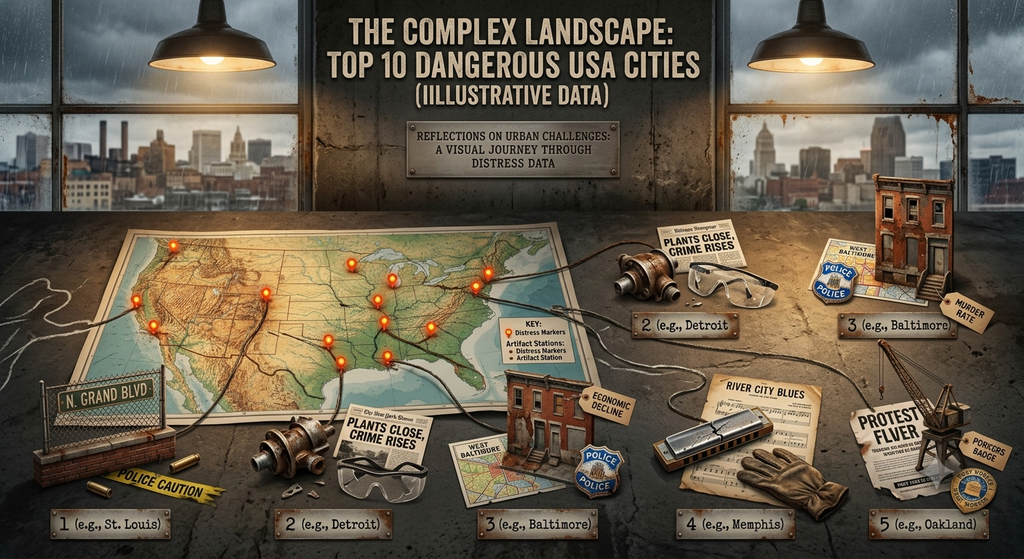
The United States is home to thousands of cities, each with its own character, economy and challenges. While the vast majority of Americans live ordinary lives without experiencing serious violent crime, some cities have historically recorded substantially higher levels of violent crime than others.
It is important to note that calling a city simply “dangerous” can be misleading. Crime can vary dramatically between neighborhoods, and different rankings use different measurements. The discussion below focuses primarily on violent-crime and homicide trends reported by law-enforcement agencies and research organizations.
1. Memphis, Tennessee
Memphis has frequently appeared in discussions of U.S. cities with high violent-crime rates. The city has experienced significant levels of homicide, robbery and aggravated assault. At the same time, crime statistics can vary considerably from year to year, making current local data important when evaluating trends.
2. Baltimore, Maryland
Baltimore has faced longstanding challenges involving violent crime, particularly homicide and aggravated assault. However, recent data show an important change: the Council on Criminal Justice reported that Baltimore’s homicide rate in the first half of 2026 was substantially lower than during the same period in 2019.
This illustrates why historical reputation alone should not be used to describe a city’s current crime situation.
3. Detroit, Michigan
Detroit has historically recorded elevated levels of violent crime compared with many other large American cities. Homicide, robbery and aggravated assault have been important components of the city’s crime profile.
Like other major cities, Detroit has also experienced changes in crime patterns in recent years, demonstrating the importance of looking at recent statistics rather than relying only on older rankings.
4. New Orleans, Louisiana
New Orleans has long attracted attention because of its homicide and violent-crime rates. Crime can vary significantly across different parts of the city, however, and citywide statistics do not mean that every neighborhood has the same level of risk.
Tourism is also a major part of New Orleans’ economy, meaning that understanding specific locations and circumstances is more useful than applying a single label to the entire city.
5. St. Louis, Missouri
St. Louis has frequently appeared near the top of lists based on violent-crime or homicide rates. Population size is particularly important when comparing cities: a relatively small number of incidents can produce a high rate when calculated per 100,000 residents.
Consequently, crime rates should always be examined alongside the underlying number of incidents.
6. Chicago, Illinois
Chicago is one of America’s largest cities and has historically experienced substantial numbers of homicides and other violent offenses. Because of its enormous population, its total number of crimes can look particularly large even when comparing rates produces a different picture.
Recent nationwide trends also show that homicide has declined considerably from the peaks observed earlier in the decade.
7. Cleveland, Ohio
Cleveland has faced challenges involving violent crime, including aggravated assault and homicide. Economic conditions, neighborhood-level differences and other social factors can influence crime patterns, making citywide rankings an incomplete picture of individual safety.
8. Milwaukee, Wisconsin
Milwaukee has also experienced periods of elevated violent crime. Recent research, however, shows that crime trends can change quickly. The CCJ found that across its large-city sample, reported homicide fell substantially in 2025 compared with 2024.
9. Philadelphia, Pennsylvania
Philadelphia is another major American city that has experienced significant levels of violent crime. Homicides became a major concern during the early 2020s, although recent data indicate that homicide and several other violent offenses have declined in many major U.S. cities.
10. Washington, D.C.
Washington, D.C. has historically experienced significant violent-crime challenges. Research examining 17 large U.S. cities found that Washington had the highest measured “lethality” in that particular 2024 sample, a measure defined as homicides relative to aggravated assaults and robberies.
However, this does not mean Washington is necessarily the most dangerous U.S. city overall. Different measurements can produce different results.
The Bigger Picture
One of the most important points is that America’s crime landscape is changing. According to the Council on Criminal Justice’s mid-year 2026 analysis, the average homicide rate in its sample of 30 cities was 18% lower in the first half of 2026 than in the first half of 2025. Nine of the 13 offenses examined in its broader sample were also lower during the first half of 2026.
The FBI’s national 2024 data likewise showed that estimated violent crime decreased by 4.5% compared with 2023, while property crime declined by 8.1%.
Therefore, a list of cities with historically high crime should not be interpreted as a permanent ranking of places that are unsafe. Crime changes over time, and conditions can differ dramatically from one neighborhood to another.
For anyone researching safety, the most useful approach is to examine recent city and neighborhood-level crime data, the specific type of crime, and the time period involved rather than relying on a single “most dangerous cities” list.
Leave a Reply