
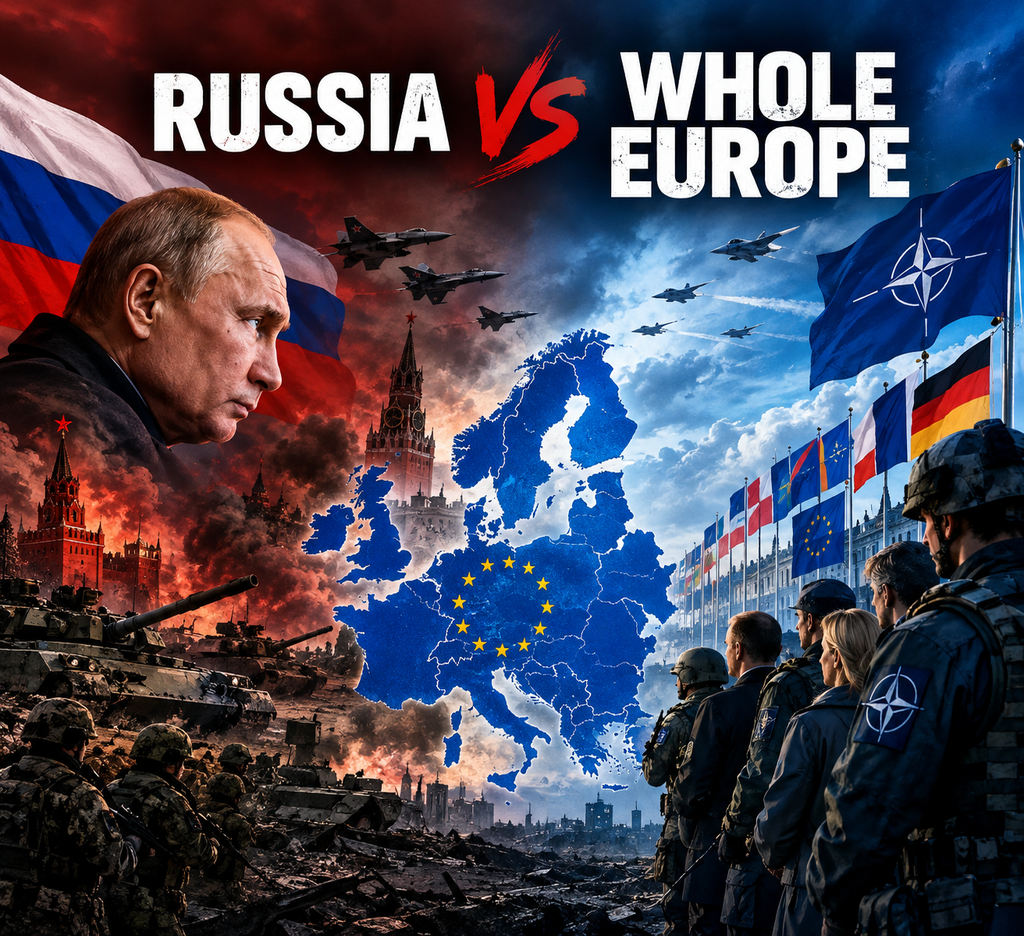
Europe’s security environment has changed dramatically since Russia launched its full-scale invasion of Ukraine in February 2022. As the war continues, European governments and NATO increasingly describe Russia not only as a military threat in Ukraine, but also as a source of cyberattacks, sabotage, disinformation, airspace incidents and other hybrid activities across Europe. (NATO)
But does this mean Russia is actually planning to attack the whole of Europe? The evidence requires a more careful distinction between military invasion and broader forms of pressure.
The Ukraine War Is at the Center
Russia’s full-scale war against Ukraine remains the largest conventional conflict in Europe. NATO describes Russia’s war as the gravest threat to Euro-Atlantic security in decades. It has consequently strengthened its eastern flank and increased its readiness across member states. (NATO)
Countries close to Russia, particularly in the Baltic region, have been especially concerned about their security. The EU has also described Russian actions and provocations toward the Baltic states as part of broader hybrid warfare.
Is Russia Attacking Other European Countries?
There is an important difference between direct military attacks and hybrid operations.
European governments and NATO have attributed or linked various activities to Russia, including cyber operations, sabotage, electronic interference, disinformation and other forms of hostile activity. NATO says Russian-linked activities have affected countries including Czechia, Estonia, Germany, Latvia, Lithuania, Poland, Sweden and the United Kingdom. (NATO)
The EU has similarly accused Russian-linked actors of conducting cyber operations against European countries. In July 2026, the EU said Russian cyber activity had targeted countries including France, Germany, Poland, the Netherlands, Austria, Slovakia, Romania and Finland.
More recently, in September 2026, the EU imposed additional sanctions over what it described as Russian foreign information manipulation and interference.
What About a Full-Scale Attack on Europe?
This is where the question becomes more complicated.
Russia is already fighting Ukraine, while most European countries are members of NATO. Under Article 5, NATO considers an armed attack against one member an attack against all, although the exact response is determined by the alliance and its members. NATO reaffirmed this commitment at its 2026 Ankara summit. (NATO)
Therefore, a conventional attack on a NATO country would carry consequences very different from Russia’s current hybrid activities.
At present, publicly available evidence does not establish that Russia is carrying out a conventional military campaign aimed at conquering the whole of Europe. Instead, European governments and NATO are primarily warning about Russia’s broader efforts to weaken European security and influence European countries through multiple methods.
Why Are European Countries Increasing Defense Spending?
The perceived Russian threat has pushed European countries to strengthen their militaries, protect critical infrastructure and improve cyber defenses.
NATO says its eastern flank now has stronger forces and defense plans than at any point since the end of the Cold War. (NATO)
The European Union is also working on measures to protect infrastructure and respond to drone threats and other hybrid attacks. The European Council has specifically called for greater preparedness and resilience against persistent hybrid campaigns attributed particularly to Russia and Belarus.
Russia’s Position
Moscow rejects the characterization of Russia as a threat to European countries. In September 2026, Kremlin spokesman Dmitry Peskov again said Russia had no hostile intentions toward France or other European countries in response to accusations of Russian interference. (Reuters)
This illustrates the wider dispute: European governments and NATO describe many Russian activities as threats to European security, while the Kremlin rejects those accusations and presents NATO and Western policies as major sources of confrontation.
Conclusion
So, is Russia targeting the whole of Europe?
The available evidence points to a more complicated picture. Russia is conducting a war against Ukraine and has been accused by European governments and NATO of carrying out or supporting hybrid activities across multiple European countries, including cyber operations, sabotage, information manipulation and other forms of pressure.
However, that is different from saying that Russia is currently conducting a plan to militarily invade or conquer the whole of Europe.
The bigger concern for Europe is whether the continuing Ukraine war and expanding hybrid confrontation could produce further escalation between Russia and European countries. For that reason, European governments are strengthening defenses, protecting infrastructure and increasing cooperation through both the EU and NATO.
Leave a Reply