
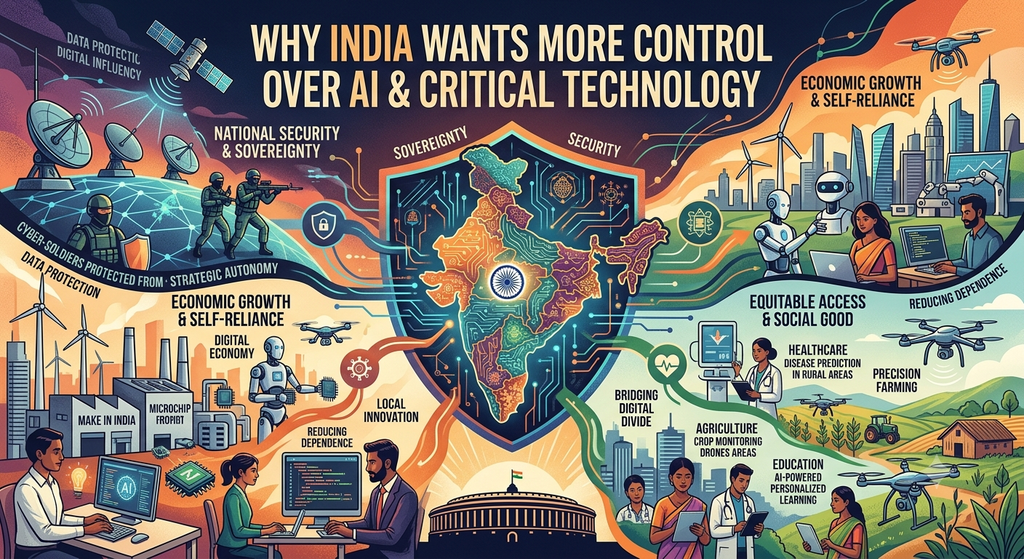
Artificial intelligence is rapidly becoming one of the most important technologies in the world. From smartphones and healthcare to defense, finance and education, AI is changing how countries and businesses operate. For India, however, the AI race is about more than creating powerful chat bots. It is increasingly about technological independence, national security and control over critical infrastructure.
India is therefore looking for ways to reduce its dependence on foreign technology and build stronger capabilities at home.
The Growing Importance of AI
AI requires much more than sophisticated software. Modern AI systems depend on powerful computer chips, enormous data centers, cloud infrastructure, advanced networking equipment and large amounts of electricity.
A handful of companies and countries currently dominate many of these technologies. This creates a strategic challenge for countries such as India. If access to advanced chips, computing infrastructure or important AI software is restricted, developing domestic AI systems can become significantly more difficult.
For India, developing its own capabilities could help reduce these vulnerabilities.
Technology and National Security
One of the biggest reasons India wants greater control over critical technology is national security.
AI is increasingly being used in areas such as cybersecurity, surveillance, intelligence analysis, autonomous systems and defense. Semiconductor technology is similarly important because advanced chips power everything from smartphones and servers to military equipment.
Depending too heavily on foreign suppliers for such technologies could create risks during international conflicts, trade disputes or supply-chain disruptions.
By developing domestic capabilities, India could have greater control over technologies that are essential to its economy and security.
India’s Push for Semiconductor Manufacturing
Semiconductors are at the center of the modern technology economy. Almost every advanced electronic device depends on them.
India has been encouraging semiconductor manufacturing and investment in chip-related infrastructure as part of its broader strategy to strengthen domestic electronics production.
Building a complete semiconductor ecosystem will not happen overnight. It requires huge investments, highly skilled workers, specialized equipment and reliable supply chains. Nevertheless, increasing domestic capacity could make India more resilient and reduce dependence on a small number of overseas suppliers.
The AI Infrastructure Challenge
Another major challenge is computing power.
Training advanced AI models requires enormous amounts of computing resources. Countries with large data-center networks and access to advanced processors have a significant advantage.
India has a large technology workforce and a rapidly expanding digital economy, but it still needs to dramatically increase access to high-performance computing if it wants to compete with the world’s leading AI powers.
Domestic AI infrastructure could also allow Indian companies and researchers to develop models specifically suited to India’s languages, culture and economic needs.
Why Technological Independence Matters
India does not necessarily need to build every piece of technology completely by itself. Instead, the goal can be to create a stronger domestic ecosystem while maintaining international partnerships.
Greater technological independence could give Indian companies more bargaining power, protect critical supply chains and encourage innovation. It could also create new opportunities for startups working in AI, robotics, semiconductors, cybersecurity and advanced computing.
The Road Ahead
India’s ambition to gain greater control over AI and critical technology represents a long-term strategic shift. The country is moving beyond simply being a major consumer and services provider and is attempting to become a stronger creator and owner of advanced technology.
The journey will be challenging and expensive, but the potential rewards are enormous. If India successfully develops its AI infrastructure, semiconductor ecosystem and research capabilities, it could play a much larger role in shaping the global technology landscape.
The AI race is no longer only about who builds the smartest model. It is also about who controls the chips, computing power, data and infrastructure behind it. For India, gaining greater control over these foundations could be one of the defining technological priorities of the coming decade.
Leave a Reply