
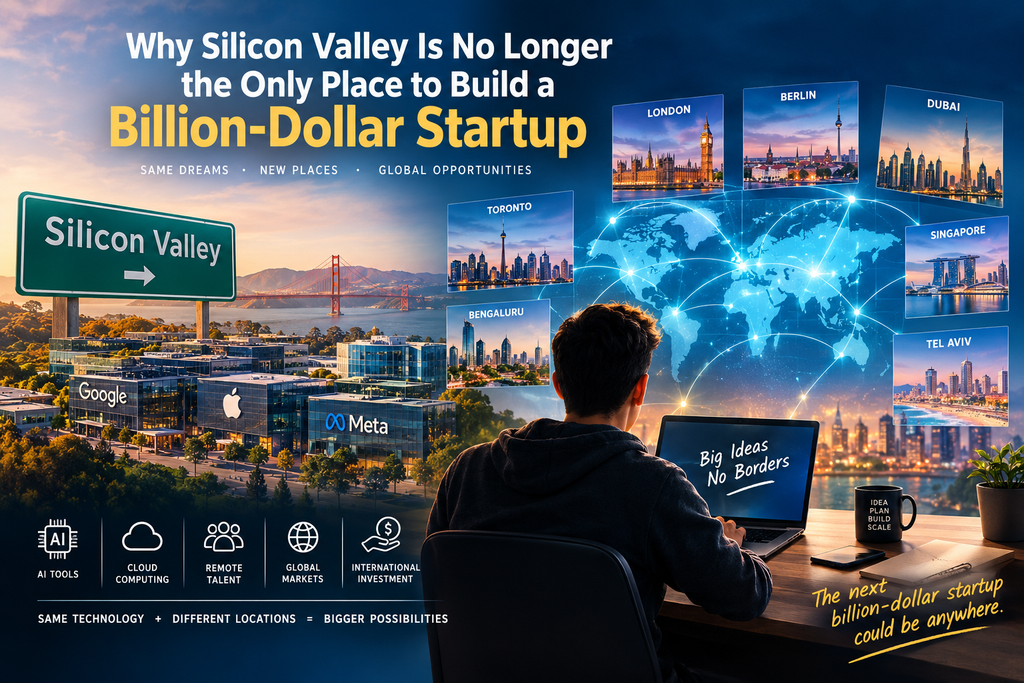
For decades, Silicon Valley was considered the ultimate destination for ambitious entrepreneurs. Companies such as Apple, Google, Meta, and many other technology giants were built around the San Francisco Bay Area, creating the perception that a world-changing startup needed to be located in Silicon Valley.
But the startup world is changing rapidly.
Today, entrepreneurs can build global companies from cities such as London, Bengaluru, Singapore, Dubai, Paris, Toronto, and Tel Aviv. Access to cloud computing, artificial intelligence, remote talent, digital payments, and global online markets has dramatically reduced the importance of having a physical office in Silicon Valley.
The question is no longer “Where is your startup located?” but increasingly “What problem are you solving, and how quickly can you scale?”
The Internet Has Changed the Startup Map
One of the biggest reasons Silicon Valley’s dominance is declining is the internet.
A startup founder can now communicate with customers across the world, hire developers from different countries, run marketing campaigns internationally, and sell digital products without establishing offices in every market.
Cloud platforms also allow small teams to access computing infrastructure that previously required enormous investments. A young company can launch a product, test it with customers, collect data, and expand globally without building a huge physical infrastructure.
This has opened the door for entrepreneurs almost everywhere.
AI Is Making Entrepreneurship Even More Global
Artificial intelligence could accelerate this transformation even further.
AI tools can help entrepreneurs with coding, graphic design, marketing, customer support, research, data analysis, content creation, and business operations. This means a small team can potentially accomplish tasks that previously required much larger departments.
For entrepreneurs outside Silicon Valley, this is particularly important. They may not have access to the same local networks or large technology workforce, but AI can reduce some of those disadvantages.
An entrepreneur in India, for example, can use modern AI and cloud tools to build a product for customers in the United States, Europe, or Southeast Asia.
The geographical barriers are becoming smaller.
The Rise of Global Startup Hubs
Silicon Valley is still one of the world’s most important technology ecosystems, but it is no longer alone.
Bengaluru has developed into a major technology and startup hub, particularly in software, fin tech, AI, and business services. London has become a significant center for fin tech and technology companies. Singapore provides access to Southeast Asian markets, while Dubai has increasingly attracted entrepreneurs, investors, and technology companies.
Other cities, including Paris, Tel Aviv, Toronto, Seoul, and Berlin, have also developed strong entrepreneurial ecosystems.
Each location offers different advantages, including access to talent, investors, customers, government support, and specialized industries.
Venture Capital Is Becoming More Global
Investment is another important factor.
Historically, many ambitious technology startups needed connections with Silicon Valley investors to raise significant amounts of venture capital. Today, investors operate across borders, and international venture capital funds are increasingly looking for opportunities outside traditional startup centers.
Online communication has also made fundraising easier. Founders can present their products to investors anywhere in the world without requiring constant face-to-face meetings.
However, raising money is still challenging. Investors want strong products, talented teams, growing markets, and evidence that a company can become highly valuable.
Location alone cannot guarantee funding.
Talent Is No Longer Concentrated in One Region
Perhaps the biggest change is the globalization of talent.
A startup does not necessarily need hundreds of employees working in one office. Developers, designers, marketers, sales professionals, and consultants can work remotely from different countries.
This gives entrepreneurs access to a much larger talent pool.
For startups, it can also reduce operating costs. A company may be able to build a highly capable international team without paying the enormous office and labor costs associated with major technology hubs.
What Silicon Valley Still Does Better
Despite these changes, it would be wrong to say that Silicon Valley has become irrelevant.
The region still has extraordinary advantages: experienced founders, major technology companies, world-class universities, venture capital firms, specialized talent, and a powerful network of investors and entrepreneurs.
Being surrounded by people who have already built successful companies can provide valuable knowledge and connections.
Silicon Valley is therefore likely to remain one of the world’s most important startup ecosystems.
The difference is that entrepreneurs now have more choices.
The Future of Global Entrepreneurship
The future may not belong to a single city.
Instead, we could see a world where startups are born globally from day one. A founder might live in India, hire a developer in Poland, use cloud infrastructure from a global provider, receive investment from the United States, and sell the product to customers across dozens of countries.
AI could make this model even more powerful by allowing extremely small teams to operate sophisticated businesses.
The next billion-dollar company could come from a famous technology hub—or from a city that is barely known for startups today.
Final Thoughts
Silicon Valley helped define the modern startup era, but technology has made entrepreneurship far more accessible.
The combination of AI, remote work, cloud computing, digital payments, global markets, and international investment is creating a new generation of startup ecosystems.
For aspiring entrepreneurs, this is encouraging news. You may not need to move to Silicon Valley to build something extraordinary.
The next billion-dollar startup could be built anywhere.
The new competitive advantage isn’t simply geography—it is the ability to identify a valuable problem, build a great solution, use technology intelligently, and reach customers around the world.
Leave a Reply